
.JPG)

.jpg)

.jpg)
.jpg)


Sibling rivalry is never terribly fun, and in “My Brother is an Only Child,” it can get ugly. I love the film for its genuine embodiment of Italian life, and its intense script, featuring political warfare that threatens to tear a family apart in a time of turmoil between fascism versus communism—between brother and brother.
Since the beginning, older, handsomer brother, Manrico (Riccardo Scamarcio), has overshadowed and undermined younger brother, Accio (Elio Germano), who, even from the beginning, wants to do something good for his family by becoming a priest. Unfortunately for him, a photo of a beautiful, voluptuous actress, slipped to him by his older brother, makes him fall from grace and leads to his eventual return to his parents, disgraced and forced to attend a technical school that prevents him from studying Latin. While his parents admire his older brother for his charisma and his sister, Violetta (Alba Rohrwacher), for her artistry, Accio is a sort of black sheep of the family, capturing the disdain of his parents, especially when he tries to run away from their influence and toward the imminent regrowth of fascism. Now rebelling against the communist practices of his family and his outspoken brother, he meets Manrico’s beautiful girlfriend, Francesca (Diane Fleri), and falls for her. When the fascists attempt to destroy Manrico’s car, Accio turns to the communists’ side and supports his family. But as Manrico becomes more deeply involved with communist actions against the state, Accio must decide how to help his brother and Francesca, just as he finds troubles of his own in turning against the fascist members who took him in, all culminating in a series of tumultuous events that leads to quite an exciting ending.
The acting in “My Brother” is top-notch, particularly from Elio Germano, who gives a believable, compassionate performance as Accio. In addition, Angela Finocchiaro is splendid as his unsympathetic mother who somehow arrests viewers between both her hateful and anguished tears. The script is wonderful and transforms just another coming-of-age plot or political thriller into quite a marvelous modern Italian film.
The cinematography is quite good as well, though a bit less noteworthy. My favorite shots involve Accio’s particular symbolic rites-of-passage. When he first commits to fascism, he, along with Mario, raises his arm toward the Italian flag shown from a low angle in the next shot. On the other hand, when he tears up his fascism card later, he is filmed at night with a shot using selective focus, blurring the Italian flag in the background, obstructed by a heavy black gate. This shot indicates the loss of his dedication to old Italian ideals of fascism (under Mussolini, of course), as he returns his loyalties to his family.
“My Brother is an Only Child” is an interesting film that starts with whimsical music and a comic tone but ends on a fairly heavy, dark note as an intense political thriller. In fact, the film tends to balance opposites all the way through, notably the opposing brothers and political beliefs. Though it highlights the differences between the two heated sides of communism and fascism and how they work in 1960’s Italy, the film does ultimately come down to the bonds of brotherhood and how it overcomes even the darkest times.
“My Brother is an Only Child” will open in June at the Belcourt Theater.
May 23, 2008
My Brother is an Only Child (Mio fratello è figlio unico)

May 5, 2008
Mighty Aphrodite

“Mighty Aphrodite” is a 1995 film by Woody Allen. Much like the rest of his oeuvre, the film centers around a neurotic main character who embarks on a series of misadventures in New York, exploring his interactions with various characters played by an all-star cast. On the other hand, there is something completely unique about this film that defies the conventions established by previous Allen masterworks such as “Annie Hall,” “Manhattan,” or “Hannah and Her Sisters.” “Mighty Aphrodite” incorporates elements of an ancient Greek drama, complete with a Chorus, with a tale of Woody and company in modern New York. Despite the notable change from the typical style of Woody Allen, this film still features the elements that make his films special—the arresting, witty script that never misses a beat and the truly special characters derived from the sublime technique and mastery of his creative genius.
In the film, Allen plays Lenny Weinrib, a sportswriter who adopts a child with his wife Amanda (Helena Bonham Carter). When their son, Max (Jimmy McQuaid), by age five has become a brilliant, personable young boy, Lenny’s bewilderment leads him to find his birth mother. He is surprised to discover it is Linda Ash (Mira Sorvino), a beautiful hooker with some small credits in porno flicks, manners lacking couth, and hardly the intelligence Lenny imagined her to have. Lenny then becomes obsessed with freeing her from her unsuitable lifestyle, and the rest of the film follows him in his efforts while a Greek Chorus (led by F. Murray Abraham) comments on his actions.
Comic effect is crucial to “Mighty Aphrodite.” Though Allen’s films amazingly never overlap despite the recurring thematic and stylistic elements, “Mighty Aphrodite” is its own film, right down to the seamless script with quippy, subtle one-liners and effortless dialogue. (Tiresias’ (Jack Warden) response to Allen’s question on his wife’s resistance to Jerry Bender (Peter Weller): “No, she just stuck her tongue into his mouth as far as it would humanly go.”) Essentially, the best thing about the script is that it simply never gets old. A modern comedy featuring a Greek Chorus is obviously quite rare in film, and Allen completely flips around its meaning, changing the ideal dramatic Chorus that narrates on the action to a humorous one that still narrates but provides comic relief (all the way down to Zeus’ answering machine message). Even growing out of the titular Greek theme is the clear difference between the physical structures of Allen and Sorvino, emphasizing her height and power and making her the embodiment of sexual power, or, if you will, the Aphrodite.
Naturally, Allen is a great actor in his film, and of course it is because he tailored the role of Lenny to himself and his personality. I must contend, though, that Helena Bonham Carter is an odd choice for the role of Amanda; though Carter has an “artistic” quality to her style, she is better suited for the oddball roles she has taken in recent years.
The real star of the film, though, is clearly Mira Sorvino as Linda Ash. Although her first minutes onscreen make me question that glossy 1995 Academy Award for Best Supporting Actress, particularly because I think her first lines are a bit weak and her whiny voice is an easy voice altering, I quickly change my mind when I see the complete dynamic range of acting she explores in later scenes and how effectively she acts. Her character is written brilliantly, and it is because of Allen’s splendid screenplay. In fact, I would contend that the multiple acting nominations that result from Allen’s films in general are because of the detail he pours into each script for each principal character.
Though it is not one of the most-celebrated of Woody Allen’s films, “Mighty Aphrodite” is underappreciated and still worth recognizing. The script, in itself, arises from the calculated collaboration of ancient Greece and modern New York while never slowing down in its hail of humorous quips and conversations. With this film, if Allen had not proved it already, he at least offers another example of his genius in screenwriting and blending his tireless but worn themes into something fresh and always funny. And if you have no other reason to see this film, at least see it for Mira Sorvino’s worthwhile, funny performance.
April 27, 2008
The Tin Drum (Die Blechtrommel)
 **** out of ****
“The Tin Drum” is a controversial, lengthy German epic that boldly pushes viewers to see how much they will react. Graphic sexuality, intense shots, and a disturbing story are but a few of the shocking and visceral features that are embodied in this uncanny, surreal World War II story.
In the film, a young boy named Oskar (David Bennett), with a tin drum he receives on his third birthday, narrates his life relative to changes in German society. Because of the immorality he witnesses in the adults around him, he resolves to hurl himself down a flight of stairs in order to forever stay small. Using the drum and a scream that shatters glass, he persistently revolts against the adult world around him to combat their contemptable behavior. Finally, the rest of the film follows Oskar as he falls in love, watches members of his family die, and joins a troop of dwarfs that entertains soldiers, all the while learning more about the world around him and the responsibilities he must acquire.
Throughout the film, the drum symbolizes innocence for Oskar, which additionally represents what he desires. The adult world looks immoral and repugnant to him, so he clings to the drum through the whole film because it protects him. (However, throwing it into his father's grave at the end of the film is clearly a symbolic rite of passage indicating his choice to become responsible.) Although screaming children usually deserve a good spanking, his glass-shattering cries throughout the film are a protest to adults trying to steal his “innocence.” Aside from his shameless parents, even the adults in the world around him are in the midst of a huge revolution toward National Socialism. He tries to become a moral symbol through his drum, notably when his playing disrupts and confuses the Nazi band into a rousing rendition of Strauss’ “Blue Danube,” thereby quashing their evil-inspired rally. On the other hand, the film seems to be indicating that he is nowhere near as innocent as he pretends to be (in fact, he indirectly has a hand in the deaths of many of those family members!). Moreover, children in the film are still portrayed as having some bad qualities, which proves that no one is a saint. In addition, the film criticizes Oskar for not owning up to the responsibilities of growing up, and the final scene of the film indicates that it is necessary for him to “grow.”
Oskar is one of the most captivating narrators that I have witnessed in a film. His dynamic range of inflection sometimes elicits laughter, particularly when he speaks ferociously. He makes an interesting character, and director Schlöndorff’s blend of filmic fantasy and reality inspires his unbelievable personage. As a character, he is well-acted by Bennett, who, as an 11-year-old, takes his 3-year-old body for quite a bizarre adventure. Oddly, Oskar is intelligent from birth, though I have never met a person whom was able to narrate his own emergence from the womb (in a close-up, point-of-view shot certain to disgust viewers). Because of the film's somewhat fantastic representation, though, it does support his narrative reliablity and therefore trustworthiness; it furthermore arrests the interest of viewers who are easily taken by his fascinating character.
Overall, this film is completely brilliant. Though it is a bit long and occasionally inspires some time-checking, the story (based on the even longer book by Günter Grass) is generally interesting, evoking, and "in your face." It is also certain to surprise with its unabashed, unforgiving dive into deviant sexuality involving incest and children (which invoked the wrath of many, including an Oklahoma court with laws against child pornography and minors engaging in sexual activity). Most importantly, though, this is one shocking, moralistic film that adeptly takes a look at the bizarre life of a young boy who professes the indiscretions of grown-ups while living in a rotten society affected by Nazism.
April 20, 2008
Joyeux Noël (Merry Christmas)
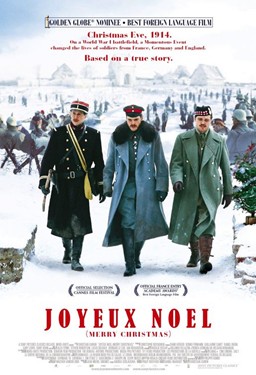
“Joyeux Noël” is a French film that inspires and promotes the idea of brotherhood, an important theme that not only relates to the fraternity of human beings, but also rejects war as a medium of resisting it. This anti-war sentiment is implied through many images in the film, which suggest the dehumanization and stupidity of men who enter the conditions of war. On the other hand, the other scenes insist on the brotherhood that men can derive whenever they realize that they are all the same. These themes are interpreted through an array of incredible stylistic and structural aspects under the direction of Christian Carion, actualizing “Joyeux Noël” as a modern French anti-war masterpiece.
“Joyeux Noël” centers on the real-life Christmas truce between the French, the Scottish, and the Germans during World War I and portrays characters such as the German tenor, Nikolaus Sprink (Benno Fürmann), his Danish opera star lover, Anna Sörensen (Diane Kruger), the German lieutenant, Horstmayer (Daniel Brühl), and the French Lieutenant, Audebert (Guillaume Canet), to encapsulate the humanity essential to its thematic heart. The film then depicts the events that follow as the characters and the three companies of soldiers share humanity in the crucial time of peace.
The structure of this film is perfect; “Joyeux Noël” readily combines many typical war-related thematic elements in a fresh way while featuring a great script and wonderful story. Christian Carion ably directs the film with a sense of pride that should leave viewers enchanted and interested during the Christmas cease fire. In addition, many stylistic aspects, such as lighting, sound, editing, and cinematography, blend perfectly together to achieve the conditions of war or of peace.
The film offers several examples that evoke the harmful effects of war, and the first example establishes a correlation between those effects and children. The opening scene features a slow dolly shot that moves toward children explaining WWI. This establishment stimulates questions of war’s effects on children, which leads viewers to realize the effects of war on younger generations. Because of the superimposition of each new child over the next, it’s like the same child speaking, though his appearance changes and his speech represents a different language. This clearly underlines the human aspect of the film. Later in the scene, the long dolly shot passes through the map in the room, and an aerial shot rushes over lands with exceptionally slight differences but notable similarities. In essence, the shot unites those lands, contending that on some level, even the land on which humans live is the same.
Death is always a consequence of war, and the film establishes that connection quickly. Death is highlighted when the Scottish man opens the door of the church at the beginning of the film, extinguishing all of the flames the priest had lit. Using a selective focus, the shot foreshadows the death (or the extinguishment) of men who go to war and prompts the overall negative view of war in general. On the other hand, that particular shot of smoking candles fades to lit candles in another room while a diva sings an operatic tune. Its implications define music as life and signify its importance in comparison to war, which explicitly infers death.
In addition to death, the film wants to implicate several more negative consequences of war for viewers, including chaos and the dehumanization of man. During the great battle early in the film, a handheld camera captures a tracking shot of the men in the trenches and on the battle and exposes the great realities of the war, particularly on the chaos involved. Using a weepy orchestral piece over the battle, the scene prominently features quick cuts and intensely loud sound effects amidst the chaos. In fact, one important attribute of the scene is crosscutting that includes shots of men and their artillery, comparing one to the other, signifying that in war, man is like, or less than, his machine. The machine robs him of his humanity and turns him into a less than human object.
The film juxtaposes war to Christmas in different ways, but intentionally to promote the concepts of peace and brotherhood. As the eve before Christmas falls, the soldiers are in their respective trenches as a Scotsman’s bagpipes erupt over the crystal silence. While he plays, the German opera stars begin to sing “Silent Night” against his song, in a sort of “battle” between the two. Eventually, the Scotsman plays the song while the Germans sing, uniting the two and creating the harmony that is essential to the film. There are several instances of two different musical cultures being united in the film, and the codes implied by their unity indicate the brotherhood significant to the film. Finally, another effect of Christmas is when Sprink crosses the snowy battlefield in an extra long shot, singing and carrying the Germans’ Christmas tree; the action of singing connects back to the idea of life while the tree becomes a symbol of peace and unity.
While incredibly dramatic and mind-opening, the film does contain some humorous elements, such as Felix/Nestor, the cat who prances through both trenches like a double agent while signifying how he is the same cat no matter what name he has. Even this one example signals the critical theme of “Joyeux Noël”: We are all the same but with different names, and thanks to brotherhood, peace can be attained. While one of endless anti-war films out there and unlike classic films like “Paths of Glory,” which is more in-your-face in its protests, essentially, Christian Carion’s “Joyeux Noël” succeeds in its propagation of peace and will surely become a film classic in years to come.
April 17, 2008
Snow Angels

The promotional poster for David Gordon Green’s “Snow Angels” says “Some will fall, some will fly,” and as far as the film is concerned, I am inclined to concur with the former. With the depression and intense dramatization that surrounds the breakdown of families, I was predisposed to initially compare the film’s circumstances to such American film classics as “Ordinary People” or “American Beauty,” but ultimately, “Snow Angels” is a pale light to either of them.
In the film, a teenaged band geek named Arthur (Michael Angarano) watches his parents split up while his co-worker Annie (Kate Beckinsale) struggles with her depressed, estranged husband, Glenn (Sam Rockwell), in small-town, U.S.A. Meanwhile, Arthur finds his first love in quirky new girl, Lila (Olivia Thurby), and Annie seeks comfort in the arms of Nate (Nicky Katt) whose lothario-like ways eventually pull apart all of his relationships, including his marriage. Eventually when Annie’s daughter goes tragically missing, everything falls apart and nothing is the same again.
On paper, this plot sounds rather complicated and intriguing, but in reality, it is neither. Segments of “Snow Angels” display how director Green is out-of-touch with so many aspects of his film, particularly in the area of character development. For example, Arthur is a relatively believable teenager until he becomes a caricature—his stash of Heineken and his bong connote a recklessness that is synonymous with adventurous youth, but obviously their random insertion tears away from the construction of Arthur’s character. Even Glenn becomes the caricature of one of those crazy people who advocates religious tapes while harboring insanity within. In addition, the collapse of the house of stacked photos that Arthur’s mother had been slowly creating conspicuously represents her fraught psyche. I think that Green cuts corners in his character development by using simple devices like these in order to reveal something about each character, meaning they are intended to be representatives of something to be believable, but this denotes a lack of ingenuity in the screenplay, and with its emphasis on character interaction, poor character development is something from which it should not suffer, but alas, it does.
One important scene worth mentioning reveals a crucial theme of the film and does indicate some of its intelligence. When Lila shows Arthur her first impressions of the town with the photos from her album, her photos exhibit several locations around the town that are covered by the film’s perpetual snow. The beauty and innocence indicated by the snowy scenes do not register with Arthur, who says he can hardly recognize any of the places in the photos even though he lives among them all. The photos are notably idealistic, as the snow in nearly every scene of the whole film is dirty, and the beauty and purity indicated by the photos are truly nonexistent. Obviously the idea of snow contrasts with the bleakness paramount to the film and proves the unrealistic ideal of the photos in comparison with the murky reality of the town. With an appropriate thematic representation like this, Green ably proves that his screenplay does hold up despite other failings that I have established.
In essence, the film does express moments of complete and utter magic, but at other times, the film descends to the levels of Lifetime movie hell. Only through the genuine acting of the main characters and moments of clever writing is the film saved from that damnation.
“Snow Angels” is playing now at the Belcourt Theater.
Originally published in the April 17 issue of Versus Magazine: Entertainment & Culture
April 10, 2008
Paranoid Park
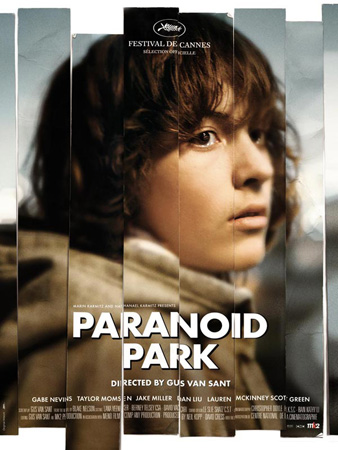
“Paranoid Park” is a moody film that interestingly and endlessly toys with style but unfortunately concludes lacking in structure. It is an experimental film that decadently enjoys the use of discontinuous editing, cinematography, and sound in its presentation. Set in Oscar-nominated director Gus Van Sant’s own backyard of Portland, Oregon, the film brings wonder to the seemingly uninspiring town with one place that enlivens its youth. Oddly enough, the titular “paranoid park” becomes an idea that is hardly transcribed into the film; although its appearance serves as the force that leads to the skateboarding protagonist’s misfortune, it hardly attributes paranoia to his psychosis, as he becomes relatively passive until the film’s end.
In the film, Alex is a 16-year-old skateboarder who accidentally kills a security guard one night. The rest of the film follows him through what happens afterward while he writes all of the preceding and transpiring events in a journal.
The whole film is derived from the perspective of this teenaged boy; at the beginning, as he writes, he apologizes because he knows his thoughts will come out-of-order, which reflects on the film, as the narrative disjunctively presents itself using discontinuous editing and an alternative-to-narrative structural system. Because the film centers on the idea of viewers following the events that transpired, several shots are re-presented and do inspire viewer participation since they actively question the discrepancy between actual circumstances and what Alex claims happens.
For “Paranoid Park,” Van Sant returns to the sort of rebellious youth for which he is well-known for interpreting in film. Relating to his oeuvre, including “My Own Private Idaho,” rebellion recurs as an important theme, as Alex’s action of striking the security guard with his skateboard while on the train signifies rebellion against authority. Alex, coming from the skateboarding subculture, is forced to represent every aspect of the socially misunderstood group, so his every action is judged. I am amazed at how Van Sant captures the perspective of a teenaged boy, and it is noticeable how much he cares for his protagonist. Van Sant is notable for his penchant for exploring misunderstood characters, and his take on apathetic Alex is no different.
The film features incredible cinematography, editing, and especially sound. Sound and lighting often display the inner psyche of Alex. One incredible example of sound is the shower scene where the soft sound of the running water slowly builds to the sound of torrential rain, which expresses the tension and anxiety building in him. Though sound does tend to interpret Alex’s mentality, there are instances of anempathy, where the music is driven by external forces trying to affect him, but they usually do not, as the sound or music changes back to his interpreted state-of-mind. It is interesting to note how sounds in his environment are often louder than normal, like there is meticulous attention being paid to them, oddly contrary to Alex’s typical apathetic opinion of his environment. Besides sound effects, Nino Rota’s music from “Juliet of the Spirits” is used quite frequently, and its use seems to be related to the power of Alex’s subconscious, like Giulietta in Fellini’s 1965 film.
Cinematography in the film is characterized by interesting mobile framing, including relatively unrelated scenes of skateboarders, who sometimes fill the voids between shots. With an amateur feel produced by a handheld, low-grade video camera, these long shots offer the depth of beauty, realism, and understanding that Van Sant wants to provide to viewers who do not comprehend skateboarders. Framing has another effect in the film, as one of my favorite shots is the pan and zoom that locks Alex in the frame during his interrogation, isolating him. This presents isolation as a key theme because it visually facilitates understanding of Alex’s situation—he is quite alone in all that is happening to him, with only himself to rely upon.
Because the film is presented in a disconnected order and the narrative is sometimes relentlessly slow, hardly anything happens of significance; thus, it ultimately provides no narrative pay-off. The film’s plot essentially revolves around the accident that results in the security guard’s death and some on what happens afterward. The ending is incredibly anticlimactic, but it is to be expected, particularly since the narrative drifts and Alex, through whom the film is portrayed, expresses unbelievable apathy to it all. In fact, he is apathetic to almost everything—his friends who jibe him about having sex, his sexually-driven cheerleader girlfriend, his caring friend, and his relatively non-existent parents. Alex’s parents are usually obscured or out-of-focus, demonstrating their lack of support or meaning in his life. However, his father is presented only once when he offers help, of which Alex refuses. Alex is a solitary being in the film, and his rebellion and passivity are his defining traits.
Though Van Sant’s effort on “Paranoid Park” is contrary to the apathy of his protagonist character (but not the actor—a solid effort for a first-timer) and characterized by his love for those who are misunderstood, the film’s plot ultimately negates his effort and offers viewers little. It is interesting, but is just not inspiring.
It is necessary to mention that the film is a tad gruesome, but only when the security guard is explicitly seen being run over on the railroad track.
“Paranoid Park” is now showing at the Belcourt Theater.
Originally published in the April 10 issue of Versus Magazine: Entertainment & Culture
April 3, 2008
Who Framed Roger Rabbit

"Who Framed Roger Rabbit" is an extraordinary film, riskily combining live action and animation, but coming off as pure perfection. Nearly all of the material and inspiration is borrowed, but "Roger Rabbit" blends it creatively and well. In addition, mixing all of the well-known cartoon characters from different studios, including Betty Boop, Daffy Duck, and Droopy Dog, is a miracle in itself. Later films such as "Space Jam" have not been able to replicate the power that the innovative design of this film successfully touts.
The film is based on the 1981 novel, "Who Censored Roger Rabbit?," by Gary K. Wolf. In the film, Roger Rabbit is a cartoon character who worries that his wife, sexy Jessica Rabbit, is playing "pattycake" with someone else. When that person turns out to be Toontown and Acme Company owner Marvin Acme, it all hits the fan once Acme turns up dead and Roger becomes the prime suspect. Eddy Valliant (Hoskins), the detective who took the tell-all photos of Jessica and Acme, is Roger’s last hope for clearing his name and uncovering the real killer and the larger devious plot.
Bob Hoskins is fantastic as the grumpy detective who “don’t work for toons!” Titular character Roger Rabbit is an entertaining alternative to everyone’s favorite, carrot-chompin’ Bugs Bunny. With no contest, the highlight of the film is one Jessica Rabbit, who exudes sexuality from her sultry eyes to rich rouge hair to the slit in her dress sliding up her thigh to her large breasts. She says, “I'm not bad. I'm just drawn that way.” She is the epitome of the film noir femme fatale.
Film noir itself is the greatest inspiration for this film, from the detective protagonist to the femme fatale to the mystery and intrigue. The film obviously draws on such classic films as "The Maltese Falcon" (dead partner) and "Chinatown" (sales of local resource—there water, here the train system, and the photos showing infidelity).
Particularly because of the cultural coding established by film noir, the 40's-inspired art direction is fantastic and delightfully appropriate. Sitting and hand-drawing every cell of animation must have been tedious, but the finished product shines. Other aspects of the film worth mentioning include the sound and sound mixing, which were fantastic. Robert Zemeckis also does a fabulous job behind the camera, bringing this cartoon-laden mystery to life. The only slight drawback worth mentioning is Alan Silvestri’s score, which sticks out like a sore thumb because everything about it screams "Back To The Future." However, this was a more obvious problem in his earlier work. The score is enjoyable nonetheless.
The film’s theme seems to be a clash between old and new. One example is the direct comparison and contrast between the older and newer ‘toons, notably Betty Boop and Jessica Rabbit. Though Betty proudly claims, “I’ve still got it,” the men in the bar quickly direct their attention to the alluring gaze and erotic frame of Jessica when she appears. Another example is how Judge Doom attempts to erase Toontown and create freeways with his Cloverleaf Corporation—this could again be another direct example of the old phrase “out with the old, in with the new.” Besides the narrative, the film itself brings about the heralding moment of film since it so astonishingly combines live action with animation as never before.
This film is a wonder and a favorite. Everything about this film is outstanding because it venerably draws on many sources of classic film and animation and creatively delivers distinct, awe-inspiring stylistic elements. Roger Rabbit truly deserved its numerous Academy Awards, including Best Film Editing, Sound Effects Editing, and Visual Effects, and a Special Achievement Award for Animation Direction. Audiences will laugh, but they will also be captivated with the suspense. This zany masterpiece does target audiences of all ages, but adults will capture the innuendo better. Everything about this film is flawless.
March 27, 2008
4 Months, 3 Weeks, & 2 Days (4 luni, 3 săptămâni şi 2 zile)
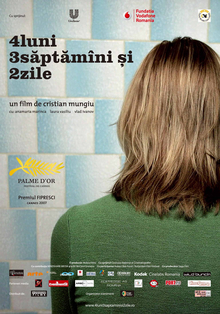
“4 Months, 3 Weeks, and 2 Days” is a powerful, evocative film that dares to challenge conventional morals and filmmaking, ultimately crafting a moody, suspenseful, real, and sometimes gruesome picture. The color of each scene is remarkably bleak, with good reason; an abortion is no happy matter.
In the film, two young women, college roommates named Otilia and Gabita, try to arrange an illegal abortion for Gabita. After Otilia arranges the entire event at a nearby hotel, the pair meets shady Mr. Bebe for the life-changing procedure. What happens afterward will arrest the attention of audiences until the surprising end.
The film features stunning performances from its actors, but Otilia (Anamaria Marinca) in particular, whose role is raw and inspired. This hardly neglects Gabita (Laura Vasiliu), though, who played her foolish character to perfection. “4 Months” relies intensively on its script for action, with heavy dialogue carrying the plot. Though few films can be carried for two hours on words alone, this one grasps the attention of viewers and never lets go. Being so completely dialogue-driven, musical sound has hardly a place in this film, and it is noticeably absent. All that happens in this film must be accomplished by what is spoken or what is not spoken in the silence.
The film’s greatest achievement besides script and direction is in a partnership of cinematography and editing, where the takes are incredibly long and the framing depends on utilizing shots that involve characters applying offscreen space. This film is all about hiding and maintaining secrets, and with a dialogue-driven story, conversations that take place with characters outside the shot enhance the sense of secrets. Again, though lengthy, deliberate shots can become quite boring after some time, this film ceaselessly maximizes its capacity for captivation with each shot. Going back to dialogue, it is also particularly useful for maintaining the interest level of these shots, and it is also important to note again that both what is seen and what is spoken incorporate something to hide by enhancing silence and offscreen space.
Cristian Mungiu makes a fantastic film, but with its laudable filmmaking, there are a few less-than-praiseworthy things worth mentioning. Though almost completely dead-on with its dialogue, the narrative leaves some important questions unanswered. If a viewer is like me, I am certain he or she is also wondering who Gabita’s baby’s father is, though some viewers may not. Though it is clear that the film’s focus is in the now and not on what happened or what will happen, such details being removed makes me recall the 1993 film, “Philadelphia,” which raised many of the same questions, removing much of the main character’s past in favor of the issue at hand. Although this does work for “4 Months,” it is not entirely satisfying for viewers to leave the theater questioning such details. Despite the uncertain past, at least the film incorporates a similarly uncertain future for the characters at the film’s end. This complete uncertainty, though, can be rewarding as far as the film is concerned, but it is hardly as rewarding to viewers.
Overall, viewers will be on the edge of their seats for most sequences. I should also mention that this film is not for viewers who become easily queasy—some sequences hold nothing back.
“4 Months, 3 Weeks, and 2 Days” is now showing at the Belcourt Theater.
Originally published in the March 27 issue of Versus Magazine: Entertainment & Culture
March 26, 2008
The Band's Visit (Bikur Ha-Tizmoret)

“The Band’s Visit” is a charming Israeli film by first-time director Eran Kolirin, who makes a masterpiece with his first time at bat. With Arab-Israeli tensions still affecting the world today, Kolirin takes audiences on a journey beyond geographic, linguistic, and cultural boundaries with ordinary people who find friendship in each other.
In the film, an Egyptian police band travels to Israel to play at the opening of an Arab Cultural Center, but ends up lost in a small town full of some humorous people and laugh-out-loud adventures. In the vein of comedies like “Napoleon Dynamite,” this one takes an all-too-funny approach at humor by slowing the wit and making viewers appreciate each paced moment. Some of the funniest scenes come from slow and awkward moments, particularly when Haled schools an Israeli boy on how to be nice to his unfortunate, unattractive date at the roller rink and when the band’s clarinetist mournfully plays everyone his unfinished “concerto.”
Defying expectation is one of the greatest attributes of comedy, as well, and it is achieved in the man who waits day and night at the pay phone for his love to finally call. In fact, the entire film relies on the characters, whose individual quirkiness generates the overall humor. Superior acting definitely plays a role in achieving the film’s humor based on character, and the actors who play Tewfiq, Dina, and Haled, in particular, finely-tune their characters’ attributes to perfection.
From the first shot of the film, an establishing shot on a white van fit snugly between two columns, there seems to be a sense of confinement, and after the van rolls away, the neatly-lined Egyptian police band in the background stands between two more columns, further hinting at this idea. The type of confinement they represent is perhaps geographic and cultural, particularly since the whole group always looks so out-of-place wherever they are at the beginning of the film, but while cinematography threatens to confine these characters, they depend on reaching past confinement for understanding.
Tewfiq, who is frequently mistaken for a General, outwardly represents the Arabic militant opposition that endlessly inflicts Israelis. His persona, instead, reveals a human who hardly resembles the Israel perception of the group to which he belongs. When Tewfiq first meets Dina, she casually says, “Here there is no Arab culture. Also, no Israeli culture. Here there is no culture at all.” She intends to promote the film’s intention of breaking down cultural barriers to reveal the humans underneath. The characters can only communicate in the international standard language of English, which does represent another barrier for the two parties, but it proves that by reaching past barriers comes understanding, and understanding is what is required of these characters (and humans, in general) in learning about each other.
Overall, with incredible humor and a human message, “The Band’s Visit” represents a triumph of the human spirit.
“The Band’s Visit” is now playing at the Belcourt Theater.
Originally published in the March 20 issue of Versus Magazine: Entertainment & Culture
Oscar-Nominated Live Action Short Films '07
The Academy Award for the Live Action Short Film falls in with the most unrecognized awards of Oscar night. The miniature counterparts of Best Picture nominees and usually as first-rate as those films, they too often fall through the cracks because of their lack of promotion outside of film festivals or art house theaters. Because of this, they also miss the attention of the average American who complacently enjoys the newest box office smash. Despite this, this forthcoming Sunday will herald a new winner, and out of the following five films, I believe one will attain this distinguishment.
“The Substitute” is an Italian short about a seemingly crazy man who decides to substitute teach until he is found out and revealed to be a businessman who chooses the wrong day for fun. The film’s first tracking shot aims to show the calamity of schoolchildren’s lives, but the following handheld mobile framing instead shows the calamity caused by the cool substitute teacher you always wish you had. The meeting room at the end of the film has a much more boring take on framing and editing, thus making the children’s world more visually dynamic compared to the adults’ world. This establishes the idea later that childhood is just a better place, more particularly because of the film’s clear moral: protecting what you value amongst temptation. Interesting and amusing, “The Substitute” is short, sweet, and to the point.
“Tanghi Argentini” is a little Dutch delight. Never lacking in humor, a clever matchmaker tries to learn the tango in order to impress a date, so he recruits his boss to show him the moves. This charming film is full of belly laughs.
An anguishing, tearful film, “At Night” is a masterpiece with a powerful script and flawless acting. Its mise-en-scène (light blue hospital rooms and dim lighting) and bleached tones contribute to the overall feeling of moroseness and somberness. Visually arresting, the frequency of close-ups and medium shots (among other fantastic shots) imparts a feeling of pain and reality in the three cancer-stricken women. The score frequents the idea of silence and its power in times of both happiness and grief. This director has complete control of the camera, and this story unfolds amongst perfection. If this one does not win the award, I will be completely surprised.
“The Mozart of Pickpockets” is a witty French film about a pair of unlucky pickpockets who lose three of their partners-in-crime and find a new one in a little deaf and mute boy. Clever in its use of off-screen space, this simple film keeps the laughs alive with its not-so-intelligent pickpocketing pair and one adorable child who confounds their work until he proves to be the titular “Mozart.” Funniest moment: the hilarious misspelling of “la maison” with “meson” and the corrective “mêson” when the little boy draws a house. Perfectly made, this film has the best chance of winning if the Academy goes “funny” again this year.
The British “Tonto Woman” is a fish among four sharks this year. The compassionate story follows a man who falls for a shunned, marked woman in the Old West and wants to help her. With creative stylistic effort in the Western dynamic, the film falls completely short everywhere else. Feeling, at best, like Hallmark’s next “hall-of-famer,” “Tonto Woman” is one big yawn with a poor story. This film is the weakest of the five films I watched; I could hardly make it through it.
The Oscars will air live on February 24th at 7 p.m. CST on ABC.
Originally published in the February 21 issue of Versus Magazine: Entertainment & Culture
NOTE: My second guess, "The Mozart of Pickpockets" won the Oscar.